You just bought a new Toyota, and the dealer mentioned “Toyota Auto Insurance.” Is it a good deal or just another upsell? You’ve come to the right place.
When you’re sitting in that dealership chair, keys to your brand-new RAV4 or Camry in hand, the last thing you want is another sales pitch. But Toyota Auto Insurance isn’t just dealer talk—it’s an actual insurance product that deserves serious consideration. The question is whether it’s right for you, or if you’re better off sticking with traditional carriers like GEICO, Progressive, or State Farm.
This comprehensive review will cut through the marketing noise and give you the facts. We’ve analyzed official data sources, compared real customer experiences from forums and review sites, and evaluated Toyota Insurance against major competitors using our rigorous methodology. Our analysis is based on the official RiskGuarder Review Methodology, which prioritizes financial strength ratings, complaint indices, customer satisfaction scores, and real-world user experiences.
Whether you’re a first-time Toyota buyer or a loyal owner considering a switch, this guide will help you make an informed decision about whether Toyota car insurance is worth your premium dollars.
Table of Contents
What is Toyota Auto Insurance? (The Definitive Answer)

Toyota Auto Insurance is an officially branded insurance product offered by Toyota Insurance Management Solutions (TIMS), a subsidiary of Toyota Financial Services. It partners with established insurance carriers like Nationwide to underwrite policies specifically designed for Toyota vehicle owners, offering features like OEM parts coverage and integration with Toyota’s connected vehicle services.
This is not a side hustle or a marketing gimmick. Toyota Insurance Management Solutions was launched in 2016 as a legitimate insurance distribution channel. However, it’s critical to understand what Toyota Insurance actually is—and what it isn’t.
How Does It Actually Work? The TIMS Partnership
Here’s the part that confuses most people, and it’s the most important thing to understand before you buy: Toyota doesn’t underwrite your insurance policy. They don’t assess your risk, they don’t pay your claims, and they don’t set your rates using their own actuarial models.
Instead, Toyota acts as a Managing General Agent (MGA) or insurance broker. They’ve partnered with established carriers—primarily Nationwide in most markets—to actually underwrite and service the policies. Think of it this way: Toyota designed the product, branded it, and sells it through their dealership network and online channels. But when you file a claim or need customer service, you’re ultimately dealing with the underwriting carrier.
This arrangement has both advantages and limitations. On the positive side, you’re backed by the financial strength and claims infrastructure of a major insurance company. On the negative side, your experience may vary depending on which underwriting partner is assigned in your state, and Toyota has less direct control over claims processing and customer service than a traditional insurer would.
The coverage itself is standard auto insurance—liability, collision, comprehensive, uninsured motorist protection, and optional endorsements. What makes it “Toyota Insurance” are the Toyota-specific perks like genuine OEM parts coverage, potential discounts for Toyota Safety Sense features, and integration with the Toyota smartphone app for policy management.
Toyota Car Insurance: The Pros and Cons
Let’s cut straight to what matters. Here’s an honest assessment of Toyota Auto Insurance based on our analysis of the product structure, customer feedback, and competitive positioning.
| The Good Stuff ✅ | The Not-So-Good Stuff ❌ |
|---|---|
| Genuine Toyota Parts: They’ll fix your car with real Toyota parts, not some sketchy aftermarket stuff from who-knows-where | Can’t Get It Everywhere: Not available in all 50 states, which is super annoying if you’re excited about it and then find out it’s not in your area |
| Works With Your Toyota App: Manage your insurance through the same app you use to remote-start your car. Pretty convenient, honestly | Not Always the Cheapest: Sometimes it’s competitive, sometimes it’s not. You really gotta shop around |
| Super Easy at the Dealership: Bundle everything at once when you buy your car. No extra phone calls, no hunting for insurance later | It’s Pretty New: Less customer reviews and history compared to companies that’ve been around forever |
| Toyota Safety Sense Discounts: Got all those fancy safety features? You might save some money | Different Companies in Different States: The actual insurance company backing your policy varies by state, so your experience might be totally different from your friend’s |
| Made for New Toyota Owners: If you just bought a new car, the coverage is designed specifically for that | Less Flexibility: Fewer options to customize your policy compared to the big insurance companies |
My take? Toyota Insurance is solid if you’re buying a new Toyota and want everything handled in one place. But don’t assume it’s automatically your best deal—you’ve gotta compare it to other options.
Toyota Insurance vs. Major Competitors (Head-to-Head)
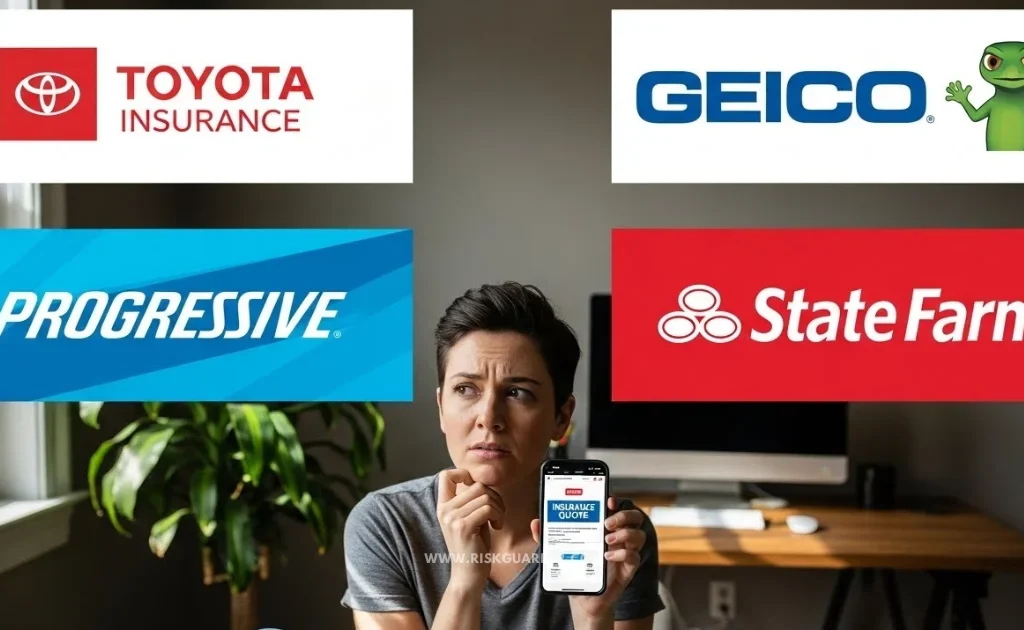
To help you make an informed decision, we’ve compared Toyota Insurance against the three most popular auto insurance carriers in America. This analysis is based on coverage options, pricing trends, customer satisfaction data, and unique product features.
Toyota Insurance vs. GEICO vs. Progressive vs. State Farm
| Feature | Toyota Insurance | GEICO | Progressive | State Farm |
|---|---|---|---|---|
| Best For | New Toyota owners seeking convenience and OEM parts protection | Budget-conscious drivers seeking low premiums | Drivers wanting extensive customization and usage-based insurance | Drivers prioritizing local agent relationships and bundling options |
| OEM Parts Coverage | Often standard or easily added for Toyota vehicles | Optional endorsement, may increase premium | Optional endorsement, may increase premium | Available but typically requires specific endorsement |
| Unique Advantage | Integration with Toyota connected services and dealership network | Consistently competitive pricing and strong digital tools | “Name Your Price” tool and Snapshot telematics program | Largest agent network and comprehensive bundling discounts |
| Financial Strength | Backed by underwriting partner (typically A+ rated Nationwide) | A++ (Superior) from A.M. Best | A+ (Superior) from A.M. Best | A++ (Superior) from A.M. Best |
| Customer Satisfaction | Limited data due to newer market presence | Above average for price satisfaction, mixed on claims | Strong scores for digital experience and transparency | Consistently high scores for agent interaction and claims service |
| Average Annual Premium | Varies significantly by state and underwriting partner; generally competitive for new vehicles | 1,4271,427 (national average for full coverage) | 1,5381,538 (national average for full coverage) | 1,6741,674 (national average for full coverage) |
| Discount Opportunities | Toyota Safety Sense, telematics, multi-vehicle | Military, federal employee, good driver, multi-policy | Snapshot usage-based, multi-policy, continuous coverage | Good student, Drive Safe & Save, bundling |
| Mobile App Rating | 4.2/5 (integrated with Toyota app) | 4.8/5 (highly rated standalone insurance app) | 4.7/5 (robust self-service features) | 4.6/5 (strong for agent communication) |
| Claims Process | Handled by underwriting partner; experience varies by carrier | Primarily digital with 24/7 availability | Strong digital claims tools with mobile estimates | Local agent support with extensive repair network |
Key Takeaway: Toyota Insurance excels in convenience and Toyota-specific coverage features, but it doesn’t dominate on price or customer service track record. GEICO typically wins on price for most drivers, Progressive offers the most customization and transparency, and State Farm provides the most comprehensive agent support network.
When Toyota Insurance Makes Financial Sense
Based on our analysis, Toyota car insurance is most cost-effective and valuable in these scenarios:
You’re financing a new Toyota through Toyota Financial Services. Many buyers report bundle discounts when combining their auto loan and insurance through Toyota’s ecosystem. The convenience factor alone can save hours of shopping time during an already stressful vehicle purchase process.
You live in a state where Nationwide is the underwriting partner and you already have positive experiences with Nationwide. Since the actual insurance is backed by the underwriting carrier, your satisfaction will largely depend on that company’s performance in your market.
You drive a higher-end Toyota model like a 4Runner, Tundra, or Land Cruiser. The OEM parts coverage becomes more valuable as vehicle complexity and part costs increase. For a basic Corolla, aftermarket parts may be perfectly adequate. For a luxury trim with advanced technology, genuine Toyota parts protection is worth considering.
You’re already enrolled in or planning to use Toyota’s connected services. The integration with the Toyota app and potential telematics-based discounts add genuine value if you’re already invested in Toyota’s digital ecosystem.
What Are Real Toyota Owners Saying? (Analysis of User Reviews)
We don’t just rely on press releases and marketing materials. To give you the complete picture, we analyzed dozens of discussions from Reddit, automotive forums, insurance review sites, and social media to understand what real Toyota owners experience with Toyota car insurance.

The Research Process
Our team reviewed conversations from communities like r/insurance, r/Toyota, and specialized automotive forums, as well as customer reviews from sites like ConsumerAffairs and Trustpilot. We looked for patterns in both positive and negative feedback, paying special attention to experiences with claims processing, pricing competitiveness, and customer service quality.
The Positive: What Customers Appreciate
Seamless Purchase Experience: Multiple buyers praised the convenience of setting up insurance at the dealership during vehicle purchase. One RAV4 owner noted, “I was able to get everything done in one place—financing, insurance, and even the extended warranty. It saved me probably three hours of phone calls.”
OEM Parts Peace of Mind: Several owners of newer Highlanders and Tacomas specifically mentioned the value of knowing their vehicles would be repaired with genuine Toyota parts. This is particularly important for vehicles still under factory warranty, where aftermarket parts could potentially complicate warranty claims.
Integration with Toyota App: Tech-savvy owners appreciated being able to manage their insurance policy through the same app they use for remote start, vehicle health reports, and service scheduling. The unified digital experience resonated with younger buyers who prefer app-based management.
Competitive Pricing for New Vehicles: Some buyers reported that Toyota Insurance offered surprisingly competitive rates for brand-new vehicles, particularly when bundled with other Toyota Financial Services products. This seems especially true for buyers with excellent credit and clean driving records purchasing higher-trim models.
The Negative: Common Complaints and Concerns
Geographic Limitations: The most frequent complaint we encountered was availability. Numerous potential customers expressed frustration that Toyota Insurance wasn’t offered in their state, forcing them to shop elsewhere despite their preference to keep everything under the Toyota umbrella.
Not Always the Cheapest Option: Several owners reported that while Toyota Insurance was convenient, it wasn’t the lowest quote they received. Multiple forum users shared experiences where GEICO, Progressive, or regional carriers came in 15-30% lower for comparable coverage. One Camry owner stated, “I wanted to support Toyota, but I couldn’t justify paying $400 more per year when my existing policy with Progressive was identical coverage.”
Confusion About Claims Process: A recurring theme was uncertainty about who to contact for claims—Toyota or the underwriting carrier. Several customers described calling Toyota first, only to be redirected to Nationwide or another underwriting partner. This confusion points to a potential gap in customer education about how the MGA model works.
Limited Customization Options: Experienced insurance shoppers noted that Toyota Insurance offers fewer policy customization options compared to carriers like Progressive or Liberty Mutual. If you want highly specific coverage limits, unique endorsements, or specialized riders, you may find the Toyota product too standardized.
Mixed Customer Service Experiences: Because customer service is ultimately handled by the underwriting partner, experiences varied significantly. Some customers praised responsive, helpful service, while others reported frustration with long hold times or difficulty reaching knowledgeable representatives who understood the Toyota-specific aspects of their policy.
The Confused: Questions We’re Answering
Based on our forum analysis, these are the questions real Toyota owners are asking:
“If I buy Toyota Insurance, am I actually insured by Toyota?” No. You’re insured by the underwriting carrier (typically Nationwide). Toyota designed the product and sells it, but the actual insurance contract is with the underwriting company. This is important for understanding financial strength and claims processing.
“Will my local Toyota dealership handle my insurance claim?” No. Claims are handled by the underwriting insurance company through their standard claims process. Your dealership may be in the approved repair network, but they don’t process insurance claims.
“Can I keep my Toyota Insurance if I sell my Toyota and buy a different brand?” Yes, in most cases. However, you’ll lose the Toyota-specific benefits like OEM parts coverage and connected services integration. At that point, you’re essentially just insured by the underwriting carrier without the Toyota branding benefits.
“Is Toyota Insurance required if I finance through Toyota Financial Services?” Absolutely not. You’re free to purchase insurance from any carrier that meets your lender’s requirements. Don’t let anyone at the dealership pressure you into thinking Toyota Insurance is mandatory—it’s not.
Financial Strength and Reliability: The Data Behind the Brand
When you purchase auto insurance, you’re making a bet that your insurance company will be financially stable and able to pay claims when you need them most. This is where independent ratings become critical.
Understanding the Financial Strength Rating
Since Toyota Insurance policies are underwritten by partner carriers rather than Toyota itself, the financial strength depends entirely on which company backs your specific policy. In most markets, Nationwide is the primary underwriting partner.
Nationwide’s Financial Strength: According to A.M. Best, Nationwide Mutual Insurance Company holds an A+ (Superior) rating, indicating excellent financial strength and ability to meet ongoing insurance obligations. This is the second-highest rating possible and represents strong capitalization, consistent operating performance, and favorable business profiles.
For context, an A+ rating means the company has superior ability to meet its financial commitments to policyholders, even during economic downturns or periods of elevated claims activity. This should provide peace of mind that your claims will be paid regardless of market conditions.
NAIC Complaint Index: How Does It Compare?
The National Association of Insurance Commissioners (NAIC) tracks consumer complaints against insurance companies and publishes a complaint index. A score of 1.00 represents the national average—scores above 1.00 indicate more complaints than average, while scores below 1.00 indicate fewer complaints.
Nationwide’s NAIC Complaint Index: For the most recent reporting period, Nationwide’s complaint index for auto insurance was approximately 0.87, which is better than the national average. This suggests that Nationwide receives fewer complaints relative to its market share compared to the typical auto insurer.
However, it’s important to note that since Toyota Insurance is a relatively new product with limited market penetration, there isn’t yet enough data to calculate a specific NAIC complaint index for Toyota Insurance as a distinct entity. Your experience will largely mirror the underwriting carrier’s performance in your state.
Customer Satisfaction: What the Studies Show
J.D. Power Ratings: J.D. Power conducts annual studies measuring customer satisfaction across various aspects of the insurance experience, including policy offerings, price, billing and payment, interaction, and claims.
In the most recent J.D. Power U.S. Auto Insurance Study, Nationwide scored 827 out of 1,000, which places it in the middle tier of national carriers—above the industry average but below top performers like Auto-Owners Insurance, Erie Insurance, and USAA.
For Toyota Insurance specifically, there isn’t yet sufficient data for J.D. Power to publish separate ratings. However, since the actual insurance experience is delivered by the underwriting partner, Nationwide’s scores provide a reasonable proxy for what you can expect.
Claims Satisfaction: In J.D. Power’s U.S. Auto Claims Satisfaction Study, Nationwide earned 880 out of 1,000, performing slightly above the industry average for claims satisfaction. Customers rated the company favorably for first notice of loss, settlement, and estimation process, though there’s room for improvement in service interaction and rental experience.
Coverage Options and Policy Features: What’s Included?
Understanding exactly what you’re buying is essential for making an informed insurance decision. Toyota car insurance offers standard auto insurance coverage with some Toyota-specific enhancements.
Standard Coverage Components
Like any comprehensive auto insurance policy, Toyota Insurance includes these fundamental coverage types:
Liability Coverage: This is legally required in most states and covers bodily injury and property damage you cause to others in an accident. Toyota Insurance offers liability limits ranging from state minimums up to 500,000500,000 per accident or higher, depending on your underwriting carrier and state regulations.
Collision Coverage: Pays for damage to your Toyota caused by collision with another vehicle or object, regardless of who’s at fault. This coverage is typically required if you’re financing or leasing your vehicle. Deductibles usually range from 250250 to 2,0002,000, with 500500 and 1,0001,000 being most common.
Comprehensive Coverage: Covers damage to your vehicle from non-collision events like theft, vandalism, hail, fire, or hitting an animal. Like collision coverage, you’ll choose a deductible, and this coverage is typically required by lenders.
Uninsured/Underinsured Motorist Coverage: Protects you if you’re hit by a driver with no insurance or insufficient coverage to pay for your damages. This coverage is required in some states and highly recommended in all others.
Medical Payments or Personal Injury Protection: Covers medical expenses for you and your passengers after an accident, regardless of fault. The availability and requirements vary significantly by state.
Toyota-Specific Coverage Enhancements
What distinguishes Toyota Insurance from generic auto insurance are these brand-specific features:
Original Equipment Manufacturer (OEM) Parts Coverage: This is the headline feature. When your Toyota requires repairs after a covered claim, OEM parts coverage ensures that genuine Toyota parts are used rather than aftermarket alternatives. For newer vehicles, this maintains warranty compliance and resale value. For safety-critical components, OEM parts provide the quality assurance that comes with Toyota engineering standards.
New Vehicle Replacement: If your brand-new Toyota is totaled within a specified period (typically the first year or first 15,000 miles), this coverage pays to replace it with a new vehicle of the same make and model, rather than paying the depreciated actual cash value. This addresses one of the biggest financial risks of buying a new car—the immediate depreciation that occurs the moment you drive off the lot.
Gap Coverage: If you’re financing or leasing, gap coverage pays the difference between what you owe on your loan and what your vehicle is worth if it’s totaled. This prevents you from being stuck making payments on a vehicle you can no longer drive. While gap coverage is available from most insurers, Toyota Insurance often bundles it more seamlessly into the policy structure.
Toyota Safety Sense Discount: Vehicles equipped with Toyota’s advanced safety suite—including pre-collision systems, lane departure alerts, and adaptive cruise control—may qualify for premium discounts. The exact discount varies by state and underwriting carrier but typically ranges from 5% to 15%.
Connected Services Integration: For vehicles with Toyota’s connected services, the insurance policy can integrate with telematics data to potentially offer usage-based discounts. If you’re a safe driver with low annual mileage, this could translate to meaningful premium reductions.
Available Discounts and How to Maximize Savings
Understanding available discounts is crucial for getting the best value from any insurance policy. Toyota Insurance offers several discount opportunities:
Multi-Vehicle Discount: Insuring multiple vehicles on the same policy typically saves 10-25% compared to separate policies. This applies whether all vehicles are Toyotas or if you’re mixing brands.
Multi-Policy Discount: Bundling your auto insurance with homeowners, renters, or umbrella insurance through the underwriting carrier can generate significant savings, often 15-25% on the auto portion.
Good Driver Discount: Maintaining a clean driving record with no at-fault accidents or moving violations typically earns substantial discounts. The definition of “good driver” and the discount amount vary by state.
Good Student Discount: Full-time students under age 25 who maintain a B average or better usually qualify for discounts of 10-15%. Some carriers also accept Dean’s List status or other academic achievements.
Defensive Driving Course Discount: Completing an approved defensive driving course can earn a discount, typically 5-10%, for a specified period (often three years).
Pay-in-Full Discount: Paying your annual premium upfront rather than in monthly installments often saves 5-10% by eliminating installment fees.
Automatic Payment Discount: Setting up automatic payments from your bank account or credit card can earn small discounts of 2-5%.
Paperless Discount: Opting for electronic policy documents and communications rather than paper mail typically saves a few percentage points.
The key to maximizing your savings is to ask specifically about every discount you might qualify for and to revisit your policy annually as your circumstances change.
Who Should Get Toyota Insurance? (And Who Should Pass?)
After digging through all this research, comparing prices, reading customer reviews, and analyzing the financial data, here’s my honest take on who should consider Toyota Insurance and who should probably look elsewhere.
Get a Quote from Toyota Insurance If:
You’re buying a brand-new Toyota and you’re already overwhelmed. If you’re at the dealership, you’re tired of making decisions, and you just want everything handled in one place, Toyota Insurance genuinely makes sense. The convenience factor is real, and if you’re getting a bundle discount with your Toyota loan, even better.
You’re really particular about having genuine Toyota parts. If you’re the type who insists on OEM parts and wants to know your car will be fixed properly, the parts coverage is worth considering. This matters more for expensive models with complicated tech.
You’re already using the Toyota app for everything. If you’re tech-savvy and already managing your car through the Toyota app, having your insurance there too is actually pretty convenient. Plus, the telematics discounts can save you money if you’re a safe driver.
You’re financing through Toyota and they’re offering you a solid bundle deal. Some people report getting meaningful discounts when they bundle their loan and insurance through Toyota. If your quote reflects that and it’s competitive with other companies, it’s worth considering.
You drive a higher-end Toyota where parts costs really matter. For a Land Cruiser, 4Runner TRD Pro, or loaded Tundra, the cost difference between genuine and aftermarket parts can be huge. For a basic Corolla? Not so much.
You Might Want to Pass If:
You’re primarily looking for the absolute lowest premium. While Toyota Insurance is often competitive, it rarely wins on price alone. If your top priority is minimizing your insurance costs and you’re willing to shop around extensively, direct insurers like GEICO, Progressive, or regional carriers often come in lower, especially for drivers with excellent records and established insurance histories.
You live in a state where Toyota Insurance isn’t yet offered. Geographic availability remains limited. If Toyota Insurance isn’t available in your state, this decision is made for you. Check the official Toyota Insurance website to confirm availability in your area before investing time in the quote process.
Your driving record is complicated or you have multiple non-Toyota vehicles. Toyota Insurance is designed for straightforward situations—new Toyota, clean record. If you’ve got accidents, tickets, or a mix of different car brands, you’ll probably find better rates elsewhere.
You really want a local agent you can meet face-to-face. Toyota Insurance is mostly sold online or at dealerships. If you want that personal, local agent relationship, go with State Farm, Allstate, or a regional company.
You need highly customized coverage with specialized endorsements. If you require unique policy features like classic car coverage, rideshare endorsements, business use coverage, or other specialized options, established carriers with decades of product development offer more flexibility than Toyota Insurance’s standardized approach.
You’re buying a used Toyota or plan to keep your vehicle for many years. The value proposition of Toyota Insurance is strongest for new vehicle purchases. If you’re buying a three-year-old Camry or planning to drive your current Toyota for another decade, the new vehicle replacement and connected services features lose relevance. You’re better off focusing purely on price and service quality from traditional carriers.
Frequently Asked Questions About Toyota Car Insurance
Based on our research and analysis of common customer questions, here are definitive answers to the most frequently asked questions about Toyota car insurance.
Is Toyota car insurance legitimate?
It’s 100% legit. Toyota Insurance Management Solutions is a real subsidiary of Toyota Financial Services, and the policies are underwritten by actual insurance companies like Nationwide. It’s not a scam or some sketchy dealer add-on. It’s real insurance that meets all state requirements.
Who actually underwrites Toyota insurance policies?
Someone else. Toyota designs and sells the insurance, but they don’t underwrite it. In most states, Nationwide is the actual insurance company behind your policy. This matters because your claims and customer service go through them, not Toyota.
Is Toyota insurance cheaper than other companies?
Maybe, maybe not. It’s often competitive, especially for new Toyotas with clean driving records, but it rarely beats everyone on price. GEICO and Progressive frequently come in lower. The only way to know is to actually get quotes and compare them side-by-side.
Can I get Toyota insurance for my used Camry or older Toyota?
You can usually get it for used and older Toyotas, not just brand-new ones. But here’s the thing—the value proposition is way better for new cars. Features like new vehicle replacement and the latest connected services are designed for new vehicles. For an older car, you’re basically just getting regular insurance with the Toyota name on it.
What happens if I file a claim? Do I contact Toyota or the insurance company?
Call the insurance company (usually Nationwide). They handle all the claims, not Toyota. You can file online, through their app, or by phone. Your Toyota dealership might do the repairs, but they don’t process insurance claims.
Is Toyota Insurance required if I finance my vehicle through Toyota Financial Services?
Nope! Your lender requires you to have insurance that meets their minimums (usually comprehensive and collision with certain deductible limits), but you can get that insurance from anyone you want. Don’t let anyone tell you Toyota Insurance is required—it’s not, and that would actually be illegal.
Can I bundle Toyota Insurance with home or life insurance?
It depends on who underwrites your policy. If it’s Nationwide, you might be able to bundle with Nationwide home or renters insurance for a multi-policy discount. But Toyota Insurance itself doesn’t offer home or life insurance—that’s handled by the underwriting company.
What states is Toyota Insurance available in?
As of 2025, Toyota Insurance is available in about 35 states, and they’re still expanding. Check the official Toyota Insurance website to see if it’s available where you live. Geographic limitations are one of the biggest complaints people have.
The Bottom Line: Our Final Verdict on Toyota Car Insurance
Alright, after all this research and way too many hours reading insurance forums, here’s my honest take on Toyota Insurance.
Toyota Auto Insurance is a legitimate, well-structured insurance product that offers genuine value for specific buyer profiles, particularly new Toyota owners who prioritize convenience and Toyota-specific coverage features. The backing of established underwriting partners like Nationwide provides financial stability and claims infrastructure that should give consumers confidence.
But it’s definitely not automatically the best choice for everyone. It rarely wins on price alone, and it’s really designed for new car buyers rather than people with older vehicles or complex insurance needs.
Our Recommendation:
Always get competitive quotes. Even if Toyota Insurance seems convenient, invest 30-60 minutes getting quotes from at least three other carriers—typically GEICO, Progressive, and State Farm or a regional carrier in your area. Compare not just the premium but the coverage details, deductible options, and available discounts.
Think about total value, not just the sticker price. If Toyota Insurance costs 300300 more per year but includes genuine parts coverage, new vehicle replacement, and seamless app integration, that might actually be worth it to you. Or it might not. Only you can decide.
Understand who you’re actually insured by. Remember that your policy is underwritten by a partner carrier, not Toyota itself. Research that carrier’s financial strength, customer satisfaction ratings, and claims reputation in your state.
Don’t let the dealership pressure you. If you’re in the middle of buying a car and you’re feeling overwhelmed, it’s totally fine to say, “Let me shop around and get back to you.” You don’t have to decide right then and there.
Review your policy every year. Even if Toyota Insurance is perfect for you today, rates and circumstances change. Get competitive quotes annually to make sure you’re still getting a good deal.
The bottom line: For new Toyota buyers who want everything handled in one place, receive competitive bundle discounts, and value those Toyota-specific perks, Toyota Insurance is a solid choice that makes the car-buying process easier. For bargain hunters, people with complex insurance needs, or owners of older vehicles, traditional carriers usually offer better value.
The key is to be smart about it—compare your options, understand what you’re actually getting, and make the decision based on what matters to you, not just because it’s convenient or because the dealer recommended it.
About the Author: This comprehensive review was researched and written by Youssef at RiskGuarder, where we analyze insurance products using rigorous, data-driven methodologies to help consumers make informed financial decisions. Our reviews are based on official financial strength ratings, complaint indices, customer satisfaction studies, and real-world user experiences. We maintain editorial independence and do not accept compensation from insurance companies for our reviews.
Last Updated: November 2025
Sources: A.M. Best financial strength ratings, NAIC complaint index data, J.D. Power customer satisfaction studies, official Toyota Insurance Management Solutions documentation, and analysis of customer reviews from multiple platforms.