Congratulations on passing your G2 road test! This is a tremendous milestone that represents newfound freedom, independence, and a major step toward adulthood. Whether you’re a sixteen-year-old who just aced your test or a parent watching your child reach this exciting moment, there’s genuine cause for celebration. However, amid the excitement, there’s one pressing question that quickly surfaces: how do I get car insurance, and why does it cost so much?
For new Ontario drivers, navigating auto insurance can feel overwhelming, confusing, and frankly, shockingly expensive. The term “auto insurance G2 certification” is something we see searched thousands of times each month, which tells us that many people believe they need a special type of insurance certification to drive with their G2 license. Let us clarify this right away: there is no separate “G2 certification” for insurance purposes in Ontario. Instead, G2 drivers must be properly insured on a standard auto insurance policy, either by being added to a parent’s existing policy or by obtaining their own coverage.
This comprehensive guide, developed using our official RiskGuarder Review Methodology, will walk you through absolutely everything you need to know about insuring a G2 driver in Ontario. We’ve designed this resource to serve both young drivers asking “how much will this cost me?” and parents wondering “how do I protect my child while managing our family budget?” By the time you finish reading, you’ll understand the rules, know your options, and have a concrete action plan for getting on the road safely and affordably.
G2 Insurance 101 — The Non-Negotiable Facts Every Ontario Driver Must Know
Alright, before we get into the money-saving tricks (which is the fun part), let’s cover the stuff that’s non-negotiable.
The Essential Summary: In Ontario, every driver operating a motor vehicle on public roads must be insured — this includes G2 license holders without exception. There is no special “G2 insurance certification” or separate product category. Instead, a G2-licensed driver must be listed on a valid Ontario auto insurance policy, whether that’s a parent’s family policy or their own individual policy. Because G2 drivers are statistically more likely to be involved in accidents due to inexperience, insurance premiums for this group are significantly higher than for fully licensed drivers with clean records. However, substantial savings are achievable through strategic planning, which we’ll explore in detail throughout this guide.
Table of Contents
A Quick Refresher — G1 vs. G2 vs. Full G License Rules in Ontario
Let me break this down real quick because it actually matters for insurance:
| License Level | Minimum Age | Driving Restrictions | Insurance Implications |
|---|---|---|---|
| G1 (Learner’s) | 16 years | Must drive with fully licensed driver (4+ years experience); No highway 400-series driving; Zero alcohol; No driving between midnight and 5 a.m. | Generally covered under supervising driver’s policy; Limited additional cost |
| G2 (Probationary) | 16+ (after passing G1 road test) | Zero alcohol tolerance; Passenger restrictions for drivers under 20 during first 6 months; Can drive unsupervised | Must be listed on policy as driver; Significant premium increase expected |
| Full G License | 17+ (after 12+ months with G2) | Standard Ontario driving rules apply | Premiums begin decreasing with experience and clean record |
The transition from G1 to G2 represents a pivotal insurance moment because the G2 driver can now operate a vehicle independently. This unsupervised driving privilege means the insurance company is now assuming substantially more risk, which directly translates to higher premiums.
According to the Insurance Bureau of Canada (IBC), drivers aged 16-24 are involved in approximately 26% of fatal collisions despite representing only about 13% of licensed drivers. This statistical reality, not arbitrary pricing, explains why G2 insurance costs what it does.
The Two Paths to G2 Insurance — And Which is Right for Your Situation
When it comes to insuring a G2 driver in Ontario, When it comes to getting insured, you’ve basically got two paths. Let’s talk about both.
Path A — Adding a G2 Driver to a Parent’s Existing Policy (Most Common)

For the vast majority of Ontario families, adding a new G2 driver to an existing parental auto insurance policy represents the most practical and cost-effective approach. This is typically the recommended path for teens who live at home, don’t own their own vehicle, and will be sharing access to family cars.
For Parents — What to Expect When Adding Your Teen:
When you call your insurance company to add your teen, have this stuff ready:
- Your kid’s driver’s license number
- Their driver’s ed certificate (if they have one — and they should, but more on that later)
- Info about which cars they’ll be driving
Now, brace yourself… adding a G2 driver to your policy typically increases your annual premium by $2,000 to $5,000. I know, I know — it hurts. And if you live in Brampton or certain parts of the GTA? It could be even higher. (Brampton, why are you like this? 😭)
For the Teen — Understanding Your Coverage Status:
When you’re added to your parent’s policy, you’ll typically be classified as either a “secondary” or “occasional” driver. This distinction matters enormously for premium calculations. As an occasional driver, the insurance company assumes you’ll drive less frequently than your parents, which results in lower premium increases. However, this classification comes with an important caveat: if you’re actually driving one of the family vehicles more often than your parents, and you’re involved in an accident, the insurance company could argue that you were misrepresented on the policy. Always be honest about driving patterns when setting up coverage.
Being on your parent’s policy means you’re building insurance history from day one. Every month that passes without an accident or ticket contributes to your driving record, which will eventually help you qualify for better rates when you’re ready to get your own policy.
Path B — Getting Your Own G2 Policy (Less Common but Sometimes Necessary)
Sometimes you don’t have a choice — maybe you bought your own car, you’re living on your own at university, or your parents don’t have a policy you can join. In that case, you’ll need your own insurance.
When an Independent Policy Makes Sense:
If you’ve purchased your own car, even an inexpensive used vehicle, you’ll need to be the primary policyholder to properly insure that asset. Similarly, if you’re living on your own — perhaps attending university in another city — having your own policy provides clarity and ensures you’re properly covered regardless of your living situation.
Setting Realistic Expectations About Cost:
We won’t sugarcoat this: obtaining your own auto insurance policy as a G2 driver in Ontario will be expensive. Very expensive. Annual premiums of $8,000 to $15,000 or even higher are not uncommon for G2 drivers seeking their own policies in high-rate areas. According to recent data analyzed by RiskGuarder, some G2 drivers in Brampton and certain Toronto neighborhoods have been quoted annual premiums exceeding $18,000.
This extreme cost reflects the statistical risk that insurers face when covering young, inexperienced drivers without the premium-moderating effect of being bundled with experienced drivers on a family policy. If you’re facing quotes in this range, it’s worth exploring whether Path A might be feasible, even if it requires some creative family negotiations.
The Ultimate G2 Insurance Checklist — 7 Proven Ways to Lower Your Premium in Ontario
Now we arrive at the section that can genuinely save you thousands of dollars. At RiskGuarder, we’ve compiled and verified the most effective strategies for reducing G2 insurance costs in Ontario. Each of these methods is legitimate, widely available, and can be combined for maximum savings.
7 Proven Ways to Get Cheaper G2 Insurance in Ontario
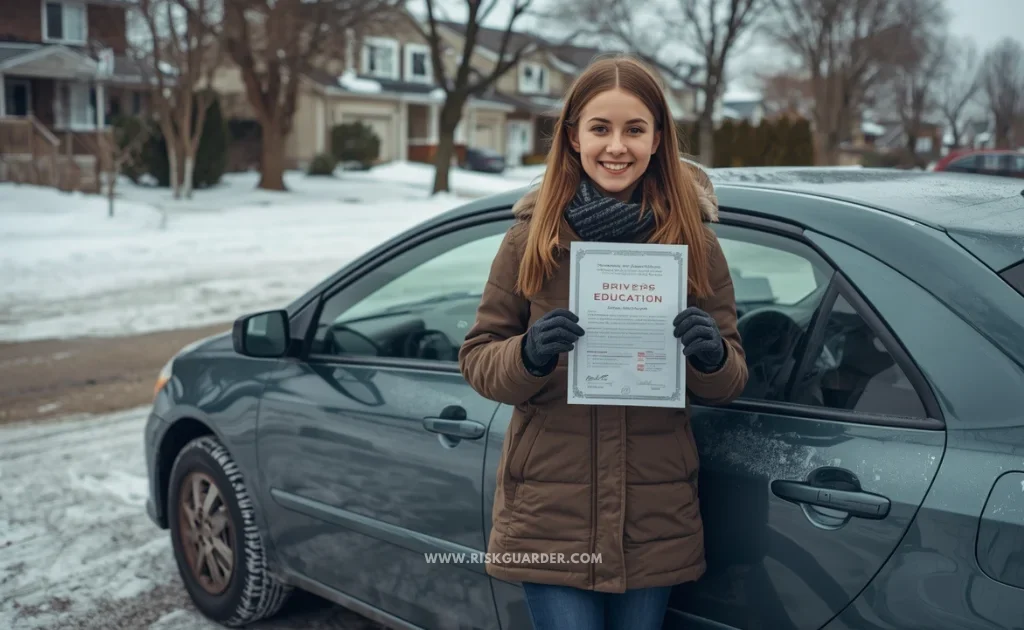
✅ 1. Complete a Ministry of Transportation Approved Driver’s Education Course
If you only do ONE thing on this list, make it this. Completing an MTO-approved driver’s education course can knock 10% to 25% off your premium.
Let’s do some quick math:
On a $6,000 premium, a 20% discount=$1,200 saved per yearOn a $6,000 premium, a 20% discount=$1,200 saved per year
That’s not pocket change! Plus, driver’s ed lets you take your G2 test after just 8 months instead of waiting the full 12. So you’re saving money AND time. Win-win.
✅ 2. Take Advantage of the Good Student Discount
Good grades pay off! Many insurers offer a discount if you’re a student with a B average (around 70-75%) or higher. We’re talking 5% to 15% off just for doing your homework.
To qualify, you’ll typically need to maintain a grade average of B (70-75%) or higher and be enrolled as a full-time student in high school, college, or university. The discount generally ranges from 5% to 15% of your premium. You’ll need to provide proof of enrollment and grades, usually a transcript or letter from your school.
This is essentially free money for students who are already performing well academically. If your grades are close to the threshold, this could be the motivation you need to push a bit harder in your studies.
✅ 3. Install Winter Tires on Your Vehicle
Since January 2016, Ontario insurance companies have been required by law to offer a discount to policyholders who install winter tires on their vehicles. This discount, typically between 2% and 5%, reflects the proven safety benefits of proper winter tires in Canada’s harsh driving conditions.
While the percentage may seem modest, it’s important to recognize that this discount applies to your entire premium. On a high-cost G2 policy, even a 3% discount can mean $150 to $300 in annual savings. Plus, you’re genuinely improving your safety during Ontario’s challenging winter months.
To claim this discount, contact your insurance provider and confirm that winter tires are installed on your vehicle during the winter season. Some insurers require proof of purchase, so keep your receipts.
✅ 4. Consider Telematics (Usage-Based Insurance Programs)
Usage-based insurance (UBI), commonly called telematics, involves installing a device in your vehicle or using a smartphone app that monitors your driving habits. These programs track factors like hard braking, rapid acceleration, nighttime driving, and total kilometers driven. Safe drivers can earn significant discounts, sometimes up to 30% or more.
Pros of Telematics for G2 Drivers:
- Provides tangible incentive to develop safe driving habits early
- Can result in substantial discounts for genuinely safe drivers
- Offers feedback that can help you improve your driving
- Demonstrates to insurers that you’re committed to safe driving
Cons to Consider:
- Your habits are being monitored, which some find intrusive
- Unsafe habits (hard braking, late-night driving) can increase premiums
- May create pressure or anxiety about driving performance
- Data privacy considerations
For G2 drivers who are confident in their safe driving habits and comfortable with the monitoring aspect, telematics programs can be an excellent way to prove their responsibility and earn meaningful discounts. Major Ontario insurers including [Insurer Names] offer robust telematics programs worth exploring.
✅ 5. Strategically Increase Your Deductible
Your deductible is the amount you pay out-of-pocket before your insurance coverage kicks in after a claim. Choosing a higher deductible — for example, $1,000 instead of $500 — will lower your monthly premium because you’re agreeing to absorb more of the financial risk yourself.
This strategy involves a calculated trade-off. By accepting a higher deductible, you’ll save money on premiums every month. However, if you are involved in an accident, you’ll need to pay more before insurance covers the remaining costs. For this approach to make financial sense, you should have emergency savings sufficient to cover your chosen deductible amount.
For young drivers with limited savings, we generally recommend being cautious with this strategy. A higher deductible only saves money if you don’t have claims — and statistically, new drivers are more likely to be involved in accidents than experienced drivers.
✅ 6. Ensure You’re Listed as a Secondary/Occasional Driver
If you genuinely are an occasional driver (not the main driver of any car), make absolutely sure that’s how you’re listed on the policy. The difference between “occasional” and “primary” can be thousands of dollars a year.
Just remember: be honest! Lying about this is insurance fraud, and it will absolutely come back to bite you.
✅ 7. Bundle Your Insurance (A Tip for Parents)
If you’ve got home insurance or tenant insurance, check if your auto insurer offers a multi-policy discount. Bundling can save you 5% to 15% across all your policies.
Also, if you’ve been with the same company for years without claims, don’t be shy about mentioning that when you’re adding your teen. A little “hey, I’ve been a loyal customer…” can sometimes go a long way.
Choosing the Right Vehicle — How Car Selection Dramatically Impacts G2 Insurance Rates
Here’s something a lot of families don’t realize until it’s too late: the car you drive massively affects your insurance costs.
How Your Vehicle Choice Impacts G2 Insurance Rates in Ontario
Insurance companies assess vehicles based on several factors when determining premiums. These include:
Safety Ratings: Vehicles with strong crash test performance from organizations like the Insurance Institute for Highway Safety (IIHS) and the National Highway Traffic Safety Administration (NHTSA) often qualify for lower premiums because they better protect occupants in collisions.
Theft Frequency: Some vehicles are stolen far more often than others. The IBC publishes an annual list of Canada’s most stolen vehicles, and insuring a car on that list will cost more.
Repair Costs: Luxury vehicles and cars with expensive parts or specialized repair requirements cost more to insure because claims are more expensive for the insurance company.
Engine Size and Performance: High-horsepower vehicles, sports cars, and performance-oriented models are associated with more aggressive driving and higher-speed accidents. Insurance premiums reflect this increased risk.
Vehicle Age: Newer vehicles cost more to replace or repair, while older vehicles have depreciated in value. However, very old vehicles may lack modern safety features.
Top 5 Recommended First Cars for Ontario G2 Drivers

Based on our analysis of safety ratings, insurance costs, reliability, and overall value, RiskGuarder recommends the following vehicles for G2 drivers:
- Honda Civic (2015-2019): Outstanding reliability, strong safety ratings, affordable parts, and reasonable insurance costs make this a perennial favorite for new drivers.
- Toyota Corolla (2015-2019): Similar virtues to the Civic with exceptional long-term reliability and low ownership costs.
- Mazda3 (2016-2020): Slightly more engaging to drive while maintaining excellent safety credentials and reasonable insurance classifications.
- Hyundai Elantra (2017-2020): Excellent value with strong warranty coverage if purchasing certified pre-owned, plus competitive insurance rates.
- Honda CR-V (2015-2018): For families preferring an SUV, this compact crossover offers good visibility, safety features, and moderate insurance costs.
Vehicles G2 Drivers Should Avoid:
- High-performance sports cars (Mustang GT, Camaro SS, WRX STI)
- Frequently stolen vehicles (certain Honda Civics from the 1990s, specific pickup trucks)
- Luxury vehicles with expensive repair costs
- Modified vehicles with aftermarket performance parts
A practical, safe, modest vehicle can mean the difference between a $5,000 annual premium and a $12,000 annual premium. This single decision may be the most financially significant choice in your G2 insurance journey.
Frequently Asked Questions — G2 Insurance Questions Answered
To ensure this guide serves as a complete resource, we’ve compiled answers to the most common questions from both G2 drivers and their parents. These answers are designed to provide clear, accurate information based on current Ontario insurance regulations.
What happens if I get a traffic ticket while driving with my G2?
Ugh, tickets are the worst. A minor speeding ticket might bump your premium up by 10-25%. More serious stuff like stunt driving? You’re looking at 50-100% increases, and some insurers might straight-up drop you.
Also, remember that G2 drivers are in the Novice Driver Escalating Sanctions program. Too many demerit points = suspended license = way bigger problems than insurance.
Can I drive a friend’s car with my G2 license?
Usually, yes! In Ontario, insurance follows the car, not the driver. So if your friend says you can drive their car, you’re covered under their insurance.
BUT — if you crash, the claim goes against their policy. So maybe don’t crash. 😬
Also, if you’re regularly borrowing someone’s car, they should really add you as an occasional driver. Otherwise, things can get messy if there’s an accident.
Do I need insurance to practice for my G road test?
Absolutely yes. Any time you’re operating a vehicle on Ontario roads, you must be insured. When practicing for your G test, you should be driving a vehicle on which you’re listed as a driver, whether that’s your parent’s policy where you’re listed as a secondary driver or your own policy.
Will my child’s tickets affect my insurance record?
If your child is listed on your policy and receives a traffic ticket, it will be associated with their driving record, not yours personally. However, because they’re insured under your policy, any premium increase resulting from their ticket will affect your policy’s overall cost. Your personal driving record remains separate, but your household’s insurance costs are impacted.
What happens when my child gets their full G license?
When your child passes their G road test and obtains their full license, you should notify your insurance company. The good news is that this transition often comes with a modest rate decrease, as fully licensed drivers are statistically somewhat safer than G2 drivers. However, significant discounts typically require years of clean driving experience — the full G license is just the beginning of building that history.
Should I make my child pay for their portion of the insurance?
Honestly? This is a personal family decision, but there’s something to be said for having them contribute. When young drivers understand the real cost, they tend to be more careful. Some families do a graduated approach — the teen pays a little at first, then more as they get older and start working.
Whatever you decide, make sure they understand WHY insurance costs what it does. That knowledge will serve them well when they’re eventually on their own.
Final Thoughts: Your G2 Insurance Action Plan
Navigating G2 insurance in Ontario doesn’t have to be overwhelming. By understanding the system, making strategic choices, and taking advantage of available discounts, you can significantly reduce costs while ensuring proper protection.
Your Next Steps:
- If you haven’t already, complete an MTO-approved driver’s education course
- Gather all necessary documents (license number, driver training certificate, vehicle information)
- Contact your family’s current insurance provider to discuss adding the G2 driver
- Request quotes from at least three different insurance companies for comparison
- Review the checklist above and implement every applicable discount strategy
At RiskGuarder, our mission is to help Canadians make informed insurance decisions based on facts and data, not marketing hype. We hope this guide has provided the clarity and confidence you need to tackle G2 insurance successfully.
Safe driving, and congratulations once again on this important milestone.
Sources and Further Reading:
- Ontario Ministry of Transportation — Graduated Licensing
- Insurance Bureau of Canada
- Financial Services Regulatory Authority of Ontario (FSRA)
- RiskGuarder Review Methodology
This article was last updated on December 8, 2025. Insurance rates and regulations change frequently. Please verify current information with a licensed insurance professional before making coverage decisions.